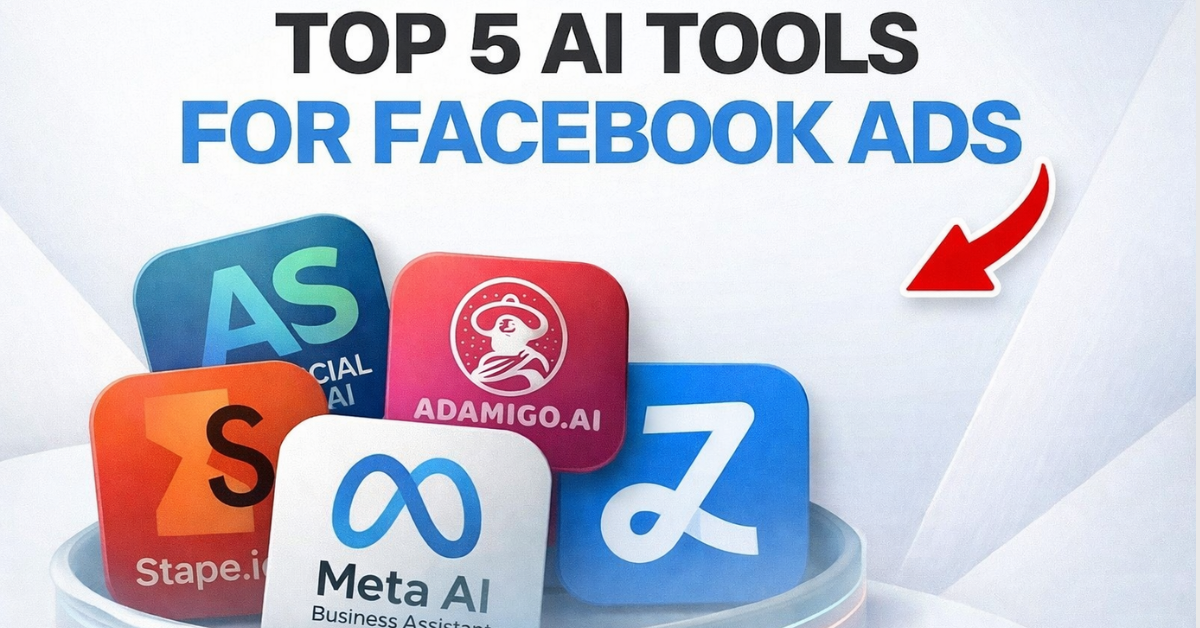


Facebook advertising in 2026 looks very different from what it was a few years ago. Privacy updates, smarter algorithms, and rising competition have made manual optimization harder than ever. At the same time, artificial intelligence has stepped in to simplify the process. Today, the best AI tools for Facebook Ads can handle audience research, creative testing, performance analysis, and even tracking issues.
If you still run ads the old way, you are probably wasting budget. Modern advertisers are turning to AI to speed up their decision-making and cut down on guesswork.
The guide presents five effective tools that solve all Facebook Ads problems, including targeting problems and data tracking issues. The tools can help both beginner marketers and experienced marketers to achieve better results.
Why AI Tools for Facebook Ads Matter in 2026
Meta advertising now requires advertisers to perform multiple tasks, which include selecting appropriate audience members and designing appealing visual content. According to Meta’s own guidelines, the key to a successful campaign really hinges on the quality of your data, thorough creative testing, and a commitment to ongoing optimization.
Here are some of the biggest hurdles advertisers are facing right now:
- Struggling to create high-performing creatives
- Poor audience targeting
- Inaccurate tracking thanks to privacy tools and ad blockers
- Spending too much time on manual data analysis
- Rising costs per conversion
This is precisely where AI tools for Facebook Ads come into play. They take on those complex tasks and deliver insights that would take humans ages to figure out.
Tool 1—Artificial Societies (Virtual Audience Testing)
One of the hardest parts of advertising is predicting performance before launch. Artificial Societies attempts to solve this problem using simulation.
This tool tests your ad on a virtual audience modeled from real behavioral data. Instead of guessing, you get measurable predictions.
Key Features
- Simulates ads on digital audience models
- Provides impact score and attention metrics
- Shows positive and negative reactions
- Helps understand audience psychology
You can test:
- Facebook and Instagram ads
- Social media posts
- Email campaigns
- Website content
For beginners, this tool removes a lot of uncertainty. Instead of launching blindly, you can refine messaging first.
While independent performance claims should always be tested in real campaigns, simulation tools align with industry practices such as pre-launch creative testing.
Tool 2—Zips Free Ad Generator (Competitor-Style Creative Builder)
Many advertisers assume image ads do not work anymore. That belief is incorrect. Meta’s own guidance states that strong visuals remain critical for engagement and conversions.
The real challenge is design—not effectiveness.
Zips Free Ad Generator simplifies this by letting you analyze competitor ads and generate similar structures for your own product.
How It Works
Looking to create a standout ad? Start by finding a successful one in the Meta Ads Library.
- Copy the image you like.
- Upload it to our tool.
- Fill in your product details.
- Generate a unique version just for you.
Remember, this process focuses on the structure, not the branding. This way, your ad remains original while still utilizing effective layouts.
This approach reflects a common marketing principle—modeling successful patterns rather than reinventing everything.
If you need free AI tools for Facebook Ads that help with creatives, this is a practical option.
Micro Blogging Sites in India for Fast Content Growth
Tool 3—Meta AI Business Assistant (Inside Ads Manager)
Not all powerful tools live outside the platform. Meta has introduced an AI assistant directly inside Ads Manager.
This feature acts like a campaign analyst available 24/7.
What It Can Do
- Identify best-performing ad sets
- Analyze campaign results
- Suggest new creative ideas
- Generate hooks and scripts
- Answer platform-related questions
For example, you can ask:
“Analyze the last 10 days and tell me which ad set performed best.”
Instead of exporting spreadsheets, the assistant provides insights instantly.
Data-driven optimization is one of Meta’s core recommendations for improving performance. Automation simply makes it faster.
For advertisers searching for Facebook Ads optimization tools or Facebook Ads automation tools, this built-in assistant is extremely valuable.
Availability may vary by region as Meta rolls out AI features gradually.
Tool 4—Amio AI (All-in-One Facebook Ads Toolkit)
Sometimes you need multiple tools in one place. Amio AI offers a collection of free utilities focused on ad creation and analysis.
Available Features
- AI image ad generator
- UGC-style image creator
- AI photoshoot generator
- Ad performance feedback (“Roast my ad”)
- Ads reports and diagnostics
- Account readiness checks
You simply upload a product image and choose a style, and the tool generates ready-to-use visuals.
User-generated content-style ads are particularly effective. Research from Nielsen shows that consumers trust relatable content more than traditional ads
This makes UGC-style creatives a strong choice for many brands.
If you want a free Facebook ads analysis tool combined with creative generation, this platform covers both areas.
Tool 5—Conversion API Setup Tool (Taplio)
Tracking accuracy has become one of the biggest challenges in digital advertising. Traditional Meta Pixel tracking depends on the user’s browser. When someone uses ad blockers or strict privacy settings, data may not reach Meta.
Incomplete data leads to poor optimization.
Meta recommends server-side tracking through the Conversion API (CAPI) to solve this problem.
Why Conversion API Matters
- This tool works seamlessly, even if you have ad blockers enabled.
- It sends data straight from the server to Meta.
- It enhances the accuracy of attribution.
- It assists the algorithm in fine-tuning campaigns.
- It minimizes data loss.
Taplio provides an easier way to set up CAPI without complex coding. Although it is not a free tool, it can significantly improve performance for businesses that rely on website conversions.
For advertisers serious about scaling, this may be one of the best AI marketing tools supporting Facebook Ads infrastructure.
How These Tools Work Together
Each tool solves a different stage of the advertising process:
Using them together creates a complete workflow—from idea to performance scaling.
Tips to Use AI Tools Without Wasting Budget
AI can be a great ally, but having a solid strategy is still crucial.
- Always back up your predictions with real-world tests.
- Keep an eye on performance on a regular basis.
- Don’t just mimic what your competitors are doing.
- Make sure your messaging is clear and straightforward.
- And don’t forget to track your conversions accurately.
Even the most advanced Facebook ad tools won’t save a weak offer or a poorly designed landing page.
Are AI Tools Replacing Human Marketers?
Not at all! While AI can speed up decision-making, it still relies on human guidance. Think of AI as a marketing calculator—it can crunch the numbers, but you’re the one who decides what to calculate. And let’s be real, AI isn’t going to take your job—unless your job was just to guess randomly!
Final Thoughts
Facebook advertising in 2026 demands smarter workflows. Rising costs and privacy changes make manual optimization inefficient.
These five AI tools for Facebook Ads address the most common problems:
- Audience confusion
- Weak creatives
- Lack of insights
- Time-consuming analysis
- Inaccurate tracking
By combining prediction tools, creative generators, analytics assistants, and server-side tracking, advertisers can solve a large portion of campaign challenges.
If you want to improve performance without burning budget, adopting AI is no longer optional—it is essential.
Start with free tools, test carefully, and scale what works. Smart advertising is not about spending more money. It is about making better decisions faster.